Easter Bunny with Daffodils Shadowbox Review
As a designer who spends more time behind an embroidery machine than at a drafting table, I approach every new digital asset with a healthy dose of skepticism. When I first loaded the Easter Bunny with Daffodils Shadowbox file, I wasn't just looking for cute aesthetics; I was evaluating structural integrity and commercial viability. This design is marketed as a 3D SVG cutting file for shadowboxes, but for those of us in the textile and apparel decoration space, it presents a unique opportunity to translate layered paper art concepts into dimensional embroidery. My immediate impression was that this design possesses a distinct visual hierarchy that translates exceptionally well to mixed-media projects, provided you understand how to adapt vector layers into stitch types.
Translating Vector Layers to Stitch Reality
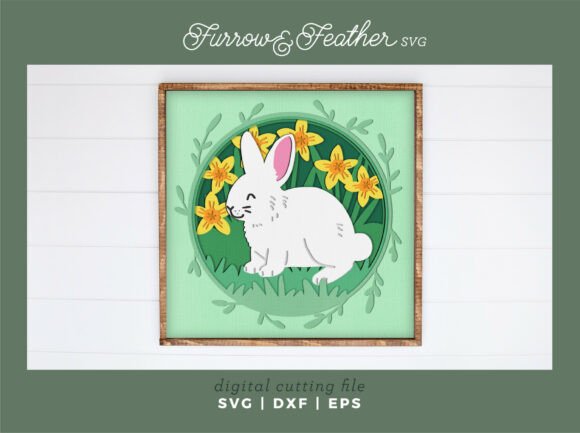
The charm of the Easter Bunny with Daffodils Shadowbox lies in its depth. In a paper shadowbox, depth is physical; in embroidery, we have to manufacture that depth through texture and contrast. Reviewing the line work, the bunny silhouette offers clean, continuous paths that are ideal for conversion. The daffodils behind the bunny provide necessary background context without overwhelming the focal point. For a professional embroidery project, this separation is crucial. It allows you to assign different stitch types to create perceived distance. I envision using a lighter density fill stitch or even a textured tatami for the daffodils to push them visually backward, while reserving plush satin columns or raised applique techniques for the bunny to bring it forward.
This design avoids the common pitfall of overly intricate internal details that get lost when scaled down. The shapes are bold enough to hold their own on fabric, which is a massive relief for anyone who has ever tried to digitize complex illustrations only to end up with a muddy, thread-heavy mess. The mood is undeniably spring-forward and nostalgic, making it an instant contender for seasonal collections that need to feel handmade rather than mass-produced.
Real-World Application: The Nursery Tote Test
To truly evaluate this asset, I mentally prototyped it for a specific client request: a personalized Easter tote bag for a toddler. This is a classic use case for Easter embroidery, but it comes with challenges. Canvas totes have a coarse fabric texture that can swallow fine details. Because the Easter Bunny with Daffodils Shadowbox relies on clear silhouettes, it performs beautifully here. I would utilize this as an applique design, using a soft minky or felt for the bunny layer to mimic the tactile quality of a physical shadowbox. The daffodils could be rendered in a running stitch outline or a light fill directly onto the canvas base.
From a business perspective, this application increases the perceived value of the finished product. Customers browsing Etsy listings or craft fair tables are drawn to dimensionality. A flat print of a bunny is generic; a textured, multi-layered embroidered interpretation feels like a premium handmade product. For Etsy sellers and small shop owners, this design bridges the gap between digital convenience and artisanal quality. It photographs well because the shadows created by the stitching add natural interest to product photos, reducing the need for heavy editing or artificial styling in your printable mockup previews.
Navigating Fabric Limitations and Hoop Constraints
While versatile, the Easter Bunny with Daffodils Shadowbox requires strategic placement. I would exercise extreme caution when attempting this on stretchy knits like lightweight t-shirts or baby onesies without significant modification. The design’s intended layered aesthetic implies multiple stitch passes. If you stack dense fills for the flowers and the bunny on a thin jersey knit, you risk creating a bulletproof patch that distorts the garment and compromises comfort. For baby embroidery, I recommend simplifying the background elements or scaling the design to fit within a smaller hoop size to reduce total stitch count and stiffness.
Dark fabrics also present a challenge. Since the original concept is based on paper shadowboxes (typically white or pastel), translating this to navy or charcoal requires rethinking your thread colors. You cannot simply invert the colors; you must adjust the value contrast to maintain the depth effect. Additionally, avoid placing this design across seams, pockets, or curved surfaces like caps unless you are an advanced digitizer capable of warping the geometry. The clean lines of the bunny will look warped and unprofessional if they don't sit flat. Always verify that your chosen stabilizer matches the weight of the design; a tear-away might not suffice for the layered look, so a cut-away or fusible mesh is often safer for maintaining registration between the floral background and the foreground character.
Commercial Viability and Brand Consistency
For creative entrepreneurs and apparel decorators, consistency is currency. The Easter Bunny with Daffodils Shadowbox has a cohesive artistic style that pairs well with other botanical or nursery-themed assets. This makes it easier to build a recognizable brand identity across different products. Whether you are creating custom apparel, pillow covers, or holiday gifts, the design maintains its personality without dominating the entire piece. It leaves adequate negative space for personalization, such as adding a child's name in a complementary font below or beside the motif.
However, before listing any item derived from this file, you must confirm the licensing terms. As a reviewer, I cannot see the specific commercial license attached to your purchase. Some designers allow unlimited sales of finished physical items but prohibit selling the digital embroidery file itself or using the artwork for print-on-demand services. Protect your business by reading the fine print. Furthermore, ensure your machine embroidery design version is original digitizing work based on the SVG, rather than an auto-digitized conversion, to avoid copyright issues related to poor-quality reproductions that misrepresent the original artist's intent.
Essential Pre-Stitch Checklist for Makers
Before you commit this design to a sellable product or a cherished gift, run through these practical checks to ensure professional results:
- Test on Scrap Fabric First: Never assume the digital preview equals reality. Stitch out the design on a scrap of the exact fabric and stabilizer combination you plan to use for the final project to check for puckering or registration errors.
- Evaluate Thread Contrast: View your thread selection in natural light. Ensure the daffodils and bunny have distinct tonal differences so the "shadowbox" effect reads clearly from a distance.
- Check Stitch Density: Inspect the design in your embroidery software. If areas are too dense for your fabric type, manually reduce the density or change the underlay to prevent needle breaks and fabric damage.
- Verify Hoop Compatibility: Measure the actual dimensions of the design against your available hoops. Remember that maximum hoop size does not always equal safe stitching area; leave margin for stabilizer grip.
- Mockup in Black and White: Convert your digital preview to grayscale. If the design looks flat or confusing without color, your value structure needs adjustment before stitching.
- Confirm Licensing: Double-check whether the license covers commercial sale of finished goods, especially if you operate a high-volume shop or sell on multiple platforms.
- Inspect Small Details: Zoom in on the SVG curves. If converting to embroidery yourself, smooth out any jagged vector nodes to ensure fluid satin stitches rather than jerky, mechanical-looking edges.
The Easter Bunny with Daffodils Shadowbox is more than just a seasonal graphic; it is a study in layering that rewards thoughtful execution. By treating it as a blueprint for texture rather than just a picture to be stitched, makers can elevate their holiday embroidery offerings significantly. Whether you are crafting a boutique collection or a single personalized gift, respecting the interplay of fabric, thread, and design structure will ensure your final creation captures the same whimsical depth as the original shadowbox concept. Always prioritize testing and material compatibility over speed, and your results will reflect the professionalism that discerning customers expect.